
Models
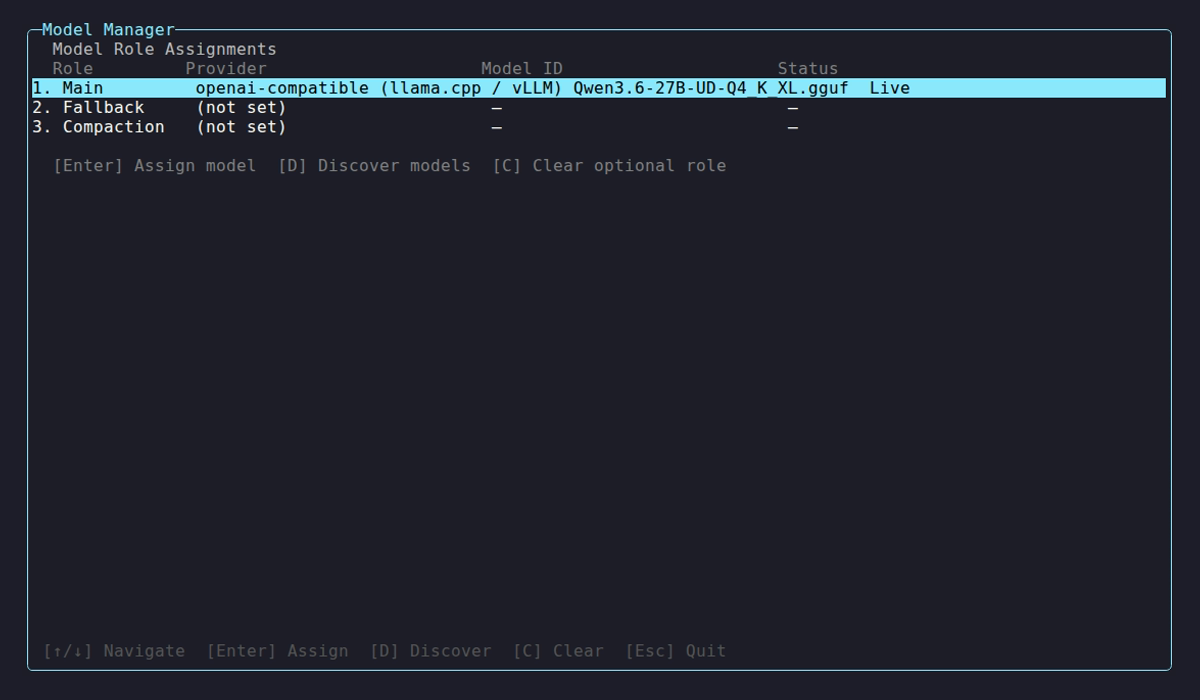
Netclaw assigns LLMs to three roles in the Models section of ~/.netclaw/config/netclaw.json: Main, Fallback, and Compaction. Only Main is required. The other two route to Main when unset.
Before assigning models, you need at least one provider configured. See Managed Providers or Self-Hosted Providers.
For CLI commands that manage models interactively, see netclaw model.
Model roles
Section titled “Model roles”| Role | Purpose | Required? |
|---|---|---|
| Main | Primary model for all interactions | Yes — defaults to qwen3:30b on local-ollama |
| Fallback | Automatic failover when Main is unavailable | No — routes to Main when unset |
| Compaction | Cheaper/faster model for context summarization | No — routes to Main when unset |
Configuration schema
Section titled “Configuration schema”Models has two halves. Definitions describe models; Roles name which definition fills each job:
{ "Models": { "Definitions": { "qwen-main": { "Provider": "remote-gpu", "ModelId": "qwen3:30b", "ContextWindow": 32768 } }, "Roles": { "Main": "qwen-main" } }}The split is what makes role changes non-destructive. Point Main at a different definition and the old one keeps its context window and modality overrides — switch back and it’s exactly as you left it.
Definition names are yours. netclaw model set generates <provider>-<model-id> (remote-gpu-qwen3-30b), but nothing depends on that shape — rename them to whatever reads well and update the roles to match. Names match case-insensitively and must be unique.
Each definition takes these fields:
| Field | Type | Default | Description |
|---|---|---|---|
Provider | string | "local-ollama" | Key into the Providers dictionary |
ModelId | string | "qwen3:30b" | Model identifier as used by the provider API |
ContextWindow | int? | null | Clamps the runtime context window in tokens; takes precedence over provider-reported value |
Provenance | enum? | null | Read-only. Set by the CLI: "Live" (discovered from provider), "Defaults" (curated defaults), or "Manual" (model set) |
InputModalities | flags enum? | null | Override input modalities, e.g. "Text, Image". Values: Text, Image, Audio, Video |
OutputModalities | flags enum? | null | Override output modalities (same values, e.g. "Text") |
And Roles takes exactly three keys — Main, Fallback, Compaction — each naming a definition. Main is required.
An omitted optional field means “detect it at runtime.” Netclaw writes no placeholder or sentinel to mean “cleared” — if ContextWindow isn’t there, detection resolves it.
Minimal config
Section titled “Minimal config”With Ollama running locally and qwen3:30b pulled, this is all you need. The Provider value must match a key you’ve defined under Providers in the same config file.
{ "Models": { "Definitions": { "qwen-main": { "Provider": "local-ollama", "ModelId": "qwen3:30b" } }, "Roles": { "Main": "qwen-main" } }}Context window is auto-detected from Ollama.
Production config
Section titled “Production config”A more realistic setup: 30B for Main, 8B for Fallback (resilience if the big model goes down), and the same 8B definition reused for Compaction, because summarization doesn’t need a big model. Two definitions, three roles:
{ "Models": { "Definitions": { "qwen-main": { "Provider": "remote-gpu", "ModelId": "qwen3:30b", "ContextWindow": 32768 }, "qwen-small": { "Provider": "remote-gpu", "ModelId": "qwen3:8b", "ContextWindow": 32768 } }, "Roles": { "Main": "qwen-main", "Fallback": "qwen-small", "Compaction": "qwen-small" } }}Two roles sharing one definition is normal — Fallback and Compaction both resolve to qwen-small here, and editing that definition moves both.
Context window resolution
Section titled “Context window resolution”Config takes precedence over anything the provider reports:
ContextWindowvalue in config (highest priority)- Provider-detected value (via
/api/show,/v1/models, etc.) - Default: 32,768 tokens
Any role-bound definition with an explicit ContextWindow must set it to at least 4,096 tokens. Definitions no role points at aren’t validated.
Set Main’s ContextWindow higher than the provider reports and netclaw logs a warning and uses your number anyway. It doesn’t refuse to boot — a detected context window is a guess, and taking down every session over a number netclaw can’t trust is worse than trying. If the number really is too big, the provider rejects the oversized request and the session compacts and retries.
Modalities follow the same precedence as the context window: an explicit value wins, then whatever’s already stored, then detection. Clearing a value with netclaw model set --clear-context-window or --clear-modalities hands that field back to detection — it doesn’t restore the value you cleared.
Capability detection
Section titled “Capability detection”Netclaw auto-detects what a model supports (context window, modalities) by walking this list until something answers:
- Built-in static catalog (covers well-known models with zero network cost)
- Ollama
/api/show— only when the provider type isollama - OpenAI-compatible
/v1/modelsmetadata — only when the provider type isopenai-compatible - OpenRouter public catalog
- HuggingFace capability resolver
- Text-only defaults (32,768 token context window)
If your provider misreports capabilities (say, an Ollama model supports vision but detection shows text-only), override detection on that definition — either by hand or with netclaw model set:
netclaw model set main remote-gpu qwen3-vl:32b --input-modalities "Text, Image"The override sticks to the definition, so it survives role reassignment.
Failover
Section titled “Failover”When Fallback is configured, netclaw wraps both models in a failover layer. If Main throws after exhausting retries, the request goes to Fallback automatically.
Retries happen first: 3 attempts with exponential backoff (1s base, 30s max, ±25% jitter). Retried errors: network failures, HTTP 408/429/5xx, TaskCanceledException, TimeoutException. Only after all retries fail does failover kick in.
There’s a catch with streaming. Failover only applies if Main fails before the first chunk reaches the caller. Once a chunk has been emitted, failures propagate directly. Splicing two model responses together mid-stream would produce garbage, so netclaw doesn’t try.
| Event | Alert Level |
|---|---|
| Main fails, Fallback takes over | provider.failover — Warning |
| Both Main and Fallback fail | provider.unreachable — Critical |
If Fallback is not configured, failed retries on Main surface the error directly.
Compaction
Section titled “Compaction”Compaction is for background LLM work: summarizing conversation context when it grows too long, generating session titles, extracting memories. These don’t need your best model. An 8B handles them fine and saves compute for actual conversations.
Compaction fires when context reaches 75% of the context window. Tune it with Session.CompactionThreshold.
Environment variable overrides
Section titled “Environment variable overrides”Override any model field with NETCLAW_ environment variables. Double underscores separate path segments, following the .NET configuration convention. Definitions and roles nest the same way as the file:
export NETCLAW_Models__Definitions__claude__Provider="openrouter"export NETCLAW_Models__Definitions__claude__ModelId="anthropic/claude-sonnet-4"export NETCLAW_Models__Roles__Main="claude"These take highest priority, overriding anything in netclaw.json. On Linux, variable names are case-sensitive.
Validation errors
Section titled “Validation errors”| Condition | Result |
|---|---|
Main Provider or ModelId is empty | Daemon boots degraded — every turn returns the No valid model configuration detected. banner |
| Fallback or Compaction is incomplete | Startup fails |
ContextWindow < 4,096 on a role-bound definition | Startup fails |
Main ContextWindow exceeds provider-reported value | Warning; netclaw uses your value |
Unknown role name in Roles | Config schema rejects it |
Provider key doesn’t exist in Providers | netclaw model set rejects it; lists configured providers |
| A role names a definition that doesn’t exist | Startup fails: Models:Roles:Main references unknown definition 'x'. |
Definitions present without Roles, or vice versa | Rejected — the canonical shape needs both |
Definitions is empty | Rejected — needs at least one definition |
| Two definitions whose names differ only by case | Rejected as duplicates |
Legacy inline roles mixed with Definitions/Roles | Rejected — pick one shape |
An unresolved role reference is the one worth watching for, since it’s easy to introduce by renaming a definition and forgetting a role. It stops the daemon at startup, and netclaw model list and netclaw doctor both name the offending reference (Models:Roles:Main references unknown definition '...'). The fix is manual — compare Roles against Definitions and make them agree.
Applying changes
Section titled “Applying changes”All model config changes require a daemon restart. There’s no daemon restart subcommand — stop and start it:
netclaw daemon stop && netclaw daemon startUnder systemd, restart the unit instead:
systemctl --user restart netclawIn Docker, restart the container: docker restart netclaw.
Verify models are picked up:
netclaw model list # reads the config filenetclaw status # shows what the running daemon is usingTypical setup sequence
Section titled “Typical setup sequence”- Configure a provider (Managed Providers or Self-Hosted Providers)
- Assign models to roles (this page, or
netclaw model set) - Restart the daemon
- Verify with
netclaw status
Related pages
Section titled “Related pages”netclaw model— CLI reference for model management (TUI,set,discover,list,clear)- Migrating Model Configuration — moving an older inline
Modelssection to definitions and roles - Managed Providers — configure cloud providers (OpenRouter, Anthropic, OpenAI)
- Self-Hosted Providers — configure Ollama, llama.cpp, vLLM
- Secrets Management — how credentials are encrypted and stored
Resources
Section titled “Resources”- Ollama model library — browse models for local inference
- Ollama modelfile parameters — context window and other model-level settings
- OpenRouter model catalog — compare models across providers with pricing
- .NET environment variable configuration — the double-underscore nesting convention
 Built by Petabridge